
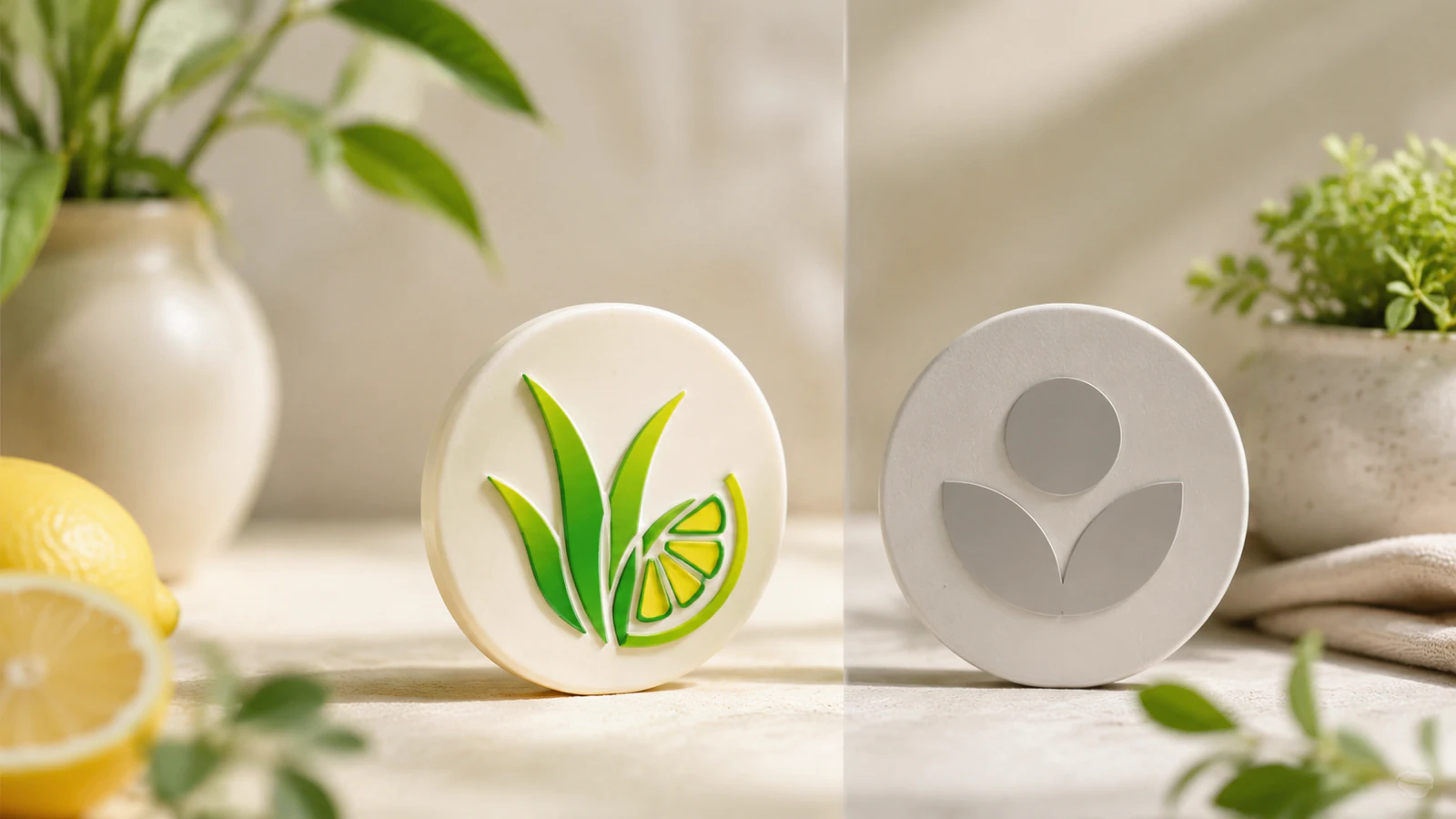
Brandmark is the logo maker people reach for when they care about design polish. It is known for clean, typography-led, minimalist marks and a one-time, lifetime pricing model with full commercial rights and even free human design tweaks. Grass Lemon is built for a different buyer: the developer who wants a generated brand mark plus the code-ready assets a web project actually ships with.
Both are one-stop logo tools, but their priorities point in opposite directions. This comparison lays out where each one wins so you can pick the one that matches your project.
The 30-second takeaway
| Grass Lemon | Brandmark | |
|---|---|---|
| Built for | Developers and vibe coders shipping web projects | Founders who want a polished, minimalist logo |
| Mark style | AI image model, 6 style presets, distinctiveness-first | Typography-led, minimalist, curated concepts |
| Human tweaks | No, fully automated | Yes, free design tweaks on request |
| 16px favicon check | Yes, live preview at 16/32/48/128px | No |
| Code-ready output | HTML, TanStack, Next snippets, metadata.json | No, design files + a one-page website + cards/social |
| Pricing | Free BYOK CLI or hosted credits | One-time $35 / $95 / $195, lifetime, full copyright |
| BYOK / open source | Yes, free local CLI | No, hosted SaaS |
What Brandmark is genuinely great at
Brandmark's reputation is earned. Its logos lean minimalist and typography-first, which is exactly the aesthetic a lot of modern startups want, and reviewers consistently rate its output among the best-looking of any AI logo maker. You describe your business, it produces a set of curated concepts, and you refine from there.
The pricing model is also a real strength. It is one-time and lifetime: $35 for Basic (PNG and vector logo files), $95 for Designer (source files, brand guidelines, a one-page website, business card designs, social media designs, presentation designs), and $195 for Enterprise (up to 10 hand-crafted original concepts plus font download). Full copyright is included for commercial and personal use, there are no monthly charges, and you can modify your logo at any time after purchase. The kicker is that Brandmark offers free human design tweaks: if you want an adjustment, their team will do it for you. That human-in-the-loop safety net is something fully automated tools do not offer.
The scope, especially at Designer and above, is a full identity package aimed at a founder starting a real company: guidelines, cards, social, presentations, even a one-page website.
What Grass Lemon does differently
Grass Lemon starts from a different premise. Its bet is that for a developer shipping a SaaS, an extension, or a side project, the things Brandmark optimizes for (presentation designs, business cards, a one-page website) are not the bottleneck. The bottleneck is getting a distinctive logo mark that survives a browser tab, plus the favicon set, an OG image, and the code to wire it all into a repo.
So Grass Lemon takes a project brief and theme colors, generates candidate marks with an image model across six aesthetic directions (geometric, color-blocks, glow, dimensional, tactile, mascot), and renders each one at real favicon sizes (16, 32, 48, 128px) before you commit. Then it packages the chosen mark into a code-oriented launch set: logo variants, a full favicon set (ICO plus PNGs plus Apple touch), an OG image, and framework code snippets (HTML, TanStack, Next, plus a metadata.json).
It is narrower than Brandmark on design breadth, and it does not offer human tweaks. It is deeper on the parts a code project actually consumes.
The mark style trade-off
This is the cleanest way to think about the difference. Brandmark optimizes for a polished, restrained, typographic look that reads as "designed." If you want a logo that feels like a real studio produced it, with clean type and a minimal mark, Brandmark is hard to beat, especially with free human tweaks to refine it.
Grass Lemon optimizes for a distinctive, generated mark that is not a safe template, and for verifying that mark at the tiny sizes where it will actually be seen. Its six style presets push toward more visual, irregular marks (a glow gradient, a dimensional fold, a tactile shape) rather than minimalist type. If your taste runs minimalist, Brandmark fits it better; if you want a mark with more visual identity and you want it checked at favicon size, Grass Lemon does that.
Code-ready output versus design breadth
Brandmark's Designer tier is broad: source files, brand guidelines, business cards, social designs, presentation designs, and a one-page website. It does not, however, output the code a developer pastes into a project. There are no favicon link tags, no framework snippets, no metadata.json.
Grass Lemon's export is the inverse: narrower on traditional brand assets, but it ships exactly what a web codebase needs, the favicon set plus an OG image plus ready-to-paste snippets for HTML, TanStack, and Next, alongside a metadata.json. For a dev project, that is the part that saves time.
Pricing and workflow
Brandmark is one-time and lifetime, $35 to $195, with full copyright and free human tweaks. You can generate unlimited concepts free and pay only to download.
Grass Lemon has a hosted credit option, plus a free, open-source BYOK (bring-your-own-key) skill and CLI. You supply your own image-model key and generate as many marks and kits as you want locally, reading your project theme and writing assets back into your repo. The trade-off is that BYOK requires obtaining a key, which Brandmark never asks for, and Grass Lemon does not hand you a human designer to refine the result.
When to use which
Use Brandmark if:
- You want a polished, minimalist, typography-led logo that reads as professionally designed.
- You value the safety of free human design tweaks and lifetime ownership with full copyright.
- You also want brand guidelines, business cards, social designs, and a one-page website.
- A one-time $35 to $95 purchase is the right unit of work for you.
Use Grass Lemon if:
- You are shipping a web, SaaS, extension, or PWA project and want code-ready output.
- You care whether the mark survives at 16px in a browser tab.
- You want a free BYOK workflow with unlimited generation rather than paying per logo.
- You want a distinctive, generated mark with more visual identity than minimalist type.
They are aimed at different buyers more than they compete head-to-head. Brandmark is the safer pick for a founder who wants a beautiful logo and a full identity package with human backup. Grass Lemon is the pick for a developer who wants a generated mark, a favicon clarity check, and the code to ship it. We are tracking the rest of the logo and favicon tool space in the comparison series.
FAQ
Is Brandmark free?
You can generate unlimited logo concepts on Brandmark for free, but you pay to download usable files. Pricing is one-time and lifetime: $35 for Basic (PNG and vector logo files), $95 for Designer (source files, brand guidelines, a one-page website, business cards, social and presentation designs), and $195 for Enterprise (adds up to 10 hand-crafted concepts and font download).
Does Brandmark include commercial rights?
Yes. Brandmark includes full copyright for use in commercial and personal projects, and you pay once for lifetime access to its design tools rather than a recurring subscription.
Does Brandmark give you code-ready assets like favicon HTML or a metadata.json?
No. Brandmark exports design files (PNG, vector, source files) plus design assets like a one-page website, business cards, and social designs. It does not output framework code snippets, favicon link tags, or a metadata.json. Grass Lemon targets code projects and ships those alongside the favicon set.
Which is cheaper if I ship many projects?
Brandmark charges per logo (a one-time $35 to $195 each, with lifetime access). Grass Lemon has a free open-source BYOK mode where you bring your own image-model key and generate as many marks and kits as you want, with the model cost passing through at provider price. For builders shipping many projects, BYOK is far cheaper.
Is Grass Lemon a good Brandmark alternative for developers?
Yes, if you want code-ready output, a 16px favicon clarity check, and a free BYOK workflow. It is weaker if your priority is a hand-polished minimalist logo or the safety of free human design tweaks, which is where Brandmark genuinely excels.